Understanding Circuit Integrity Under Fire Conditions
Fire presents unique challenges for electrical systems. Flames, extreme heat, falling debris, and water from firefighting efforts can destroy conventional cables within minutes. When cables fail, they cut power to essential systems—lighting, fire alarms, emergency communication, smoke control, and evacuation equipment—exactly when these systems are most needed.
Fire-resistant cables—sometimes called circuit integrity cables—maintain electrical circuit functionality during exposure to fire. Unlike standard cables that quickly lose insulation integrity and conductor strength, fire-resistant designs continue operating while exposed to flames and high temperatures, enabling critical systems to function throughout emergency incidents.
This circuit integrity capability distinguishes fire-resistant cables from cables with improved fire ratings. A cable rated merely as “fire-retardant” resists flame spread but provides no assurance of continued function during actual fire exposure. True fire-resistant cables undergo rigorous testing to demonstrate circuit survival under defined fire conditions.
How Fire-Resistant Cable Technology Works
Multiple construction approaches achieve fire resistance, each with distinct characteristics and applications. Mica tape wrapped around conductors provides excellent fire resistance at moderate cost. The inorganic mica mineral withstands temperatures exceeding 1000°C while maintaining electrical insulation properties, even when surrounding organic materials char or burn away.
Ceramic silicone rubber insulation represents another common fire-resistant technology. When exposed to heat, silicone rubber forms a ceramic-like protective shell that insulates conductors even as the material decomposes. This ceramic residual maintains electrical integrity through the most severe fire scenarios.
Mineral insulated (MI) cables—featuring copper or stainless steel tubes filled with compressed magnesium oxide powder—offer the highest level of fire resistance. The inorganic construction withstands extreme temperatures, mechanical abuse, and water exposure. MI cables provide the ultimate in circuit integrity but at substantially higher cost and with more demanding installation requirements.
Fire-resistant jacketing materials protect the core construction while providing additional mechanical protection. Stainless steel braiding, copper tape, and fire-rated polymer compounds address specific installation challenges while maintaining fire performance.
Critical Applications Requiring Fire-Resistant Cables
Emergency lighting systems exemplify the necessity of fire-resistant cables. When fire breaks out, occupants rely on emergency illumination to navigate toward exits. Standard cables fail quickly in fire conditions, plunging buildings into darkness precisely when safe evacuation requires visibility. Fire-resistant emergency lighting circuits ensure illumination throughout incident duration.
Fire alarm systems demand circuit integrity for obvious reasons. Detection systems must continue operating to provide fire location information to emergency responders. Control panels must maintain ability to activate suppression systems and notify building occupants. Fire-resistant cable specifications protect these life-safety circuits.
Smoke control and pressurization systems depend on reliable power to prevent smoke accumulation in stairwells and evacuation routes. Motor-operated fire dampers, smoke exhaust fans, and stairwell pressurization systems require fire-resistant power supplies to function when needed most.
Emergency communication systems—public address, mass notification, and two-way communication—enable coordinated evacuation and emergency response. Fire-resistant cable infrastructure ensures these systems remain operational throughout fire incidents.
Power distribution for critical equipment—emergency generators, fire pumps, and essential process control systems—requires fire-resistant cable runs connecting generation sources to loads. Failure of these connections can disable entire emergency systems regardless of generator capacity or pump capability.
International Standards and Testing Requirements
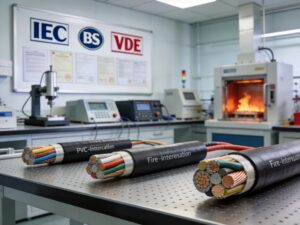
Fire-resistant cable standards establish performance criteria through standardized testing procedures. IEC 60331 defines tests for cables maintaining circuit integrity under fire conditions, specifying test temperatures, durations, and mechanical impact conditions. Different IEC 60331 parts address various test severities for different applications.
The European standard EN 50200 establishes the duration of circuit integrity maintenance—typically 30, 60, 90, or 120 minutes—allowing specification according to building characteristics and evacuation requirements. Higher ratings suit larger buildings with longer evacuation times or more complex evacuation procedures.
BS 6387 and BS 8491 specify comprehensive fire test requirements including water spray and mechanical impact exposures simulating actual firefighting conditions. Cables passing these tests demonstrate circuit integrity through the full range of stresses encountered in real fire scenarios.
North American UL 2196 provides fire-resistance testing for fire pumps and circuit integrity applications, with requirements coordinated with NFPA standards governing fire protection systems. Products carrying UL listing for fire resistance have been tested by independent laboratories to verify performance.
Specifying cables meeting recognized international standards ensures consistent performance verification regardless of cable source. Third-party certification provides assurance that products perform as documented rather than relying solely on manufacturer claims.
Design Considerations for Fire-Resistant Cable Systems
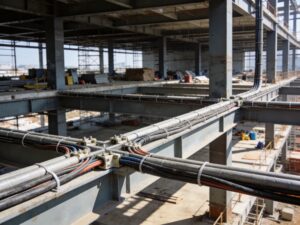
System design extends beyond cable selection to encompass routing, support, and termination practices. Fire-resistant cables must be protected from mechanical damage during installation and throughout service life. Cable tray systems, conduit, and support structures should maintain fire resistance equivalent to the cables themselves.
Segregation from non-fire-rated cables prevents damage propagation during fire conditions. A fire exposing cables in shared trays may damage fire-resistant cables through proximity heating even without direct flame contact. Separate routing or enhanced protection for shared runs addresses this risk.
Termination practices require particular attention. Terminals, splices, and connections must maintain circuit integrity through fire conditions. Fire-rated junction boxes, sealed cable entries, and protected terminal strips complement fire-resistant cable performance.
Inspection and maintenance programs ensure long-term reliability. Visual inspection for damage, periodic testing of circuit integrity, and replacement of aging cables prevent failures from deterioration or previous incident exposure.
Cost Considerations and Value Assessment
Fire-resistant cables cost substantially more than standard alternatives—typically two to five times depending on construction type and fire rating duration. This premium requires justification through risk assessment and value analysis.
Consider potential consequences of circuit failure during fire conditions. Human life risks in occupied buildings provide obvious justification for life-safety circuit fire resistance. Business interruption costs from infrastructure damage, equipment loss, and extended facility closure may exceed initial installation cost differences.
Some jurisdictions mandate fire-resistant cables for specific applications through building codes and fire regulations. Compliance requirements eliminate cost optimization options in regulated applications. Projects in unfamiliar markets should verify local requirements early in design phases.
Risk-based specification allocates higher fire ratings to higher-consequence applications while using moderate ratings or standard cables where failure consequences are lower. This approach optimizes safety investment while controlling costs for lower-risk applications.
Conclusion
Fire-resistant cables provide essential protection for critical infrastructure, ensuring electrical systems function when emergencies demand their operation most. The additional cost of fire-resistant construction translates directly to improved life safety, property protection, and business continuity.
Designing fire-resistant systems requires understanding available technologies, applicable standards, and appropriate applications. Working with experienced cable manufacturers and specifying certified products ensures systems deliver promised performance when needed.
Jinyi Cable Co., Ltd. manufactures comprehensive fire-resistant cable product lines meeting IEC, BS, and international standards. Our technical team supports critical infrastructure projects worldwide with certified fire survival cables for life-safety applications.