Why Cable Standards Matter
International trade in cable products requires navigating multiple regional standards frameworks. A cable manufactured to one standard may not automatically comply with another region’s requirements, even if construction appears similar. Understanding these standards helps procurement professionals specify appropriate products, avoid compliance problems, and streamline international sourcing.
Standards establish minimum quality thresholds, define test methods, and ensure interoperability. They protect buyers from substandard products while enabling suppliers to serve diverse markets. For project specifications, referencing appropriate standards ensures clear communication between buyers, designers, and manufacturers.
This article examines the major cable standards frameworks relevant to international trade, explaining their scope, application, and relationship to each other.
IEC: The International Framework
Overview
The International Electrotechnical Commission (IEC) develops international standards for electrical, electronic, and related technologies. IEC standards serve as the foundational technical reference for most national and regional standards worldwide. When other standards reference test methods or construction requirements, they typically trace back to IEC definitions.
IEC standards are designated with numeric part numbers. For cables, the 60038 series addresses voltages, the 60228 series addresses conductors, and various 60502 and 60840 series address cable construction. Understanding the IEC framework enables comprehension of standards that build upon or reference IEC foundations.
Key IEC Cable Standards
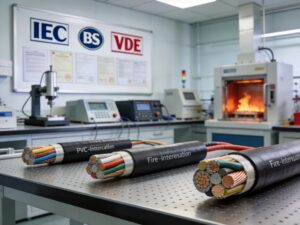
IEC 60331 defines fire resistance testing for cables, specifying test conditions and performance requirements for circuit integrity during fire exposure. Different parts address different test severities and cable types.
IEC 60332 addresses flame propagation testing, verifying that cables resist flame spread along their length. These standards form the basis for many regional fire performance requirements.
IEC 60502 covers power cables with extruded insulation for rated voltages from 1kV to 30kV. This standard defines construction requirements, test methods, and performance criteria for the most common power cable types.
IEC 60754 addresses halogen content testing, determining whether cable materials release corrosive gases when burned. This standard underlies LSZH cable specifications worldwide.
IEC 61034 measures smoke density during combustion, establishing the foundation for low-smoke cable requirements.
Using IEC Standards
IEC standards are consensus documents developed through international technical committees. They provide authoritative technical definitions but are not directly mandatory. National or regional regulations typically reference IEC standards, making IEC compliance essential for most international projects.
British Standards (BS)
Overview
British Standards represent the United Kingdom’s national standards, published by the BSI Group (British Standards Institution). BS standards have substantial influence internationally due to historical ties, Commonwealth relationships, and acceptance in many global markets. British Standards often parallel or incorporate IEC standards with UK-specific modifications.
Relevant BS Cable Standards
BS 5467 specifies PVC-insulated and PVC-sheathed power cables for fixed installation, with constructions suitable for use in various environmental conditions. The standard addresses cables up to 3.3kV with copper or aluminum conductors.
BS 6724 addresses armoured cables with thermosetting insulation for fixed installation, including improved fire performance variants. These cables serve underground, external, and industrial applications requiring mechanical protection.
BS 7835 covers low-smoke halogen-free insulated armoured cables, combining LSZH characteristics with mechanical protection for demanding applications. These cables address markets requiring both fire safety and physical durability.
BS 6387 and BS 8491 define comprehensive fire test performance for cables, including water spray and mechanical impact exposures. Cables meeting these standards demonstrate superior fire survival capability.
BS Certification
BSI offers the Kitemark certification for products meeting BS standards, providing third-party verification of compliance. Cable products bearing the Kitemark have been tested and factory audited to verify ongoing conformance.
VDE Standards (Germany/Europe)
Overview
The Verband der Elektrotechnik (VDE) publishes German standards that carry substantial international weight due to Germany’s strong manufacturing base and technical reputation. VDE standards often serve as the basis for European Norm (EN) standards, which are mandatory across European Union member states.
VDE standards are designated with VDE prefixes followed by standard numbers. Many VDE standards have parallel EN designations, making compliance verification straightforward for EU market access.
Key VDE/EN Cable Standards
VDE 0250 covers power cables for fixed installation, with multiple parts addressing different voltage classes and construction types. These standards define German requirements that closely align with European practice.
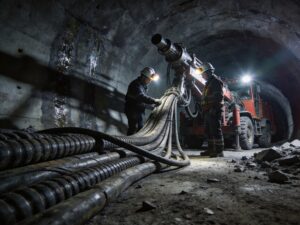
VDE 0266 addresses cables for mining applications with special flame-retardant and fire-resistant constructions. Strict requirements reflect German mining industry safety expectations.
EN 50525 (harmonized European standard) covers low-voltage power cables, replacing national standards with unified European requirements. Cables meeting EN 50525 requirements carry CE marking for EU market access.
CE Marking and EU Requirements
CE marking indicates compliance with applicable EU directives, including the Low Voltage Directive and Construction Products Regulation for cables. Achieving CE marking requires demonstrating compliance with relevant harmonized standards—often VDE-developed EN standards.
GB Standards (China)
Overview
GB standards (Guobiao Standards) represent China’s national standards system. As the world’s largest cable manufacturing base and a major consumption market, GB standards significantly influence global cable trade. Chinese export manufacturers commonly produce to GB standards while also maintaining IEC-aligned or regional certifications.
GB standards are designated GB (mandatory) or GB/T (recommended). The numbered system parallels IEC organization, with similar technical scope and test methods.
Key GB Cable Standards
GB/T 12706 covers power cables with extruded insulation for rated voltages from 1kV to 35kV, essentially the Chinese equivalent of IEC 60502. The standard defines construction and test requirements closely aligned with international practice.
GB/T 9330 addresses PVC-insulated control cables, establishing requirements for control and instrumentation applications. These cables serve industrial and building applications requiring multiple conductors.
GB 31247 establishes cable fire performance classifications, defining燃烧 performance levels for cables in building applications. This standard coordinates with international fire testing methods while establishing Chinese-specific classification requirements.
CCC Certification
The China Compulsory Certification (CCC) system requires certified products for designated application categories. Cable products within CCC scope cannot be legally sold in China without CCC certification. This certification verifies safety and basic performance requirements.
CCC certification requires testing by authorized laboratories and factory inspection by certification bodies. Foreign manufacturers can obtain CCC certification for products intended for Chinese market sale.
Harmonization and Mutual Recognition
IEC-Based Harmonization
Most regional standards intentionally harmonize with IEC technical requirements. This harmonization simplifies compliance verification—testing to IEC methods typically demonstrates compliance with regionally-derived test requirements. However, documentation and certification requirements may differ.
Regional Trade Agreements
Various regional trade agreements affect cable standards acceptance. The IECEE CB Scheme enables mutual recognition of test reports among member countries, reducing redundant testing for internationally traded products.
EU harmonization enables CE marking based on compliance with harmonized European standards. Products meeting EN standards receive automatic recognition across EU member states.
Understanding which standards apply to destination markets—and whether mutual recognition agreements simplify compliance—helps optimize international procurement strategies.
Specifying Standards for International Projects
Identifying Applicable Requirements
Project specifications should identify applicable standards based on installation location, regulatory requirements, and client preferences. Standards identification should specify the complete standard designation including part numbers and amendment versions.
For projects in unfamiliar markets, engaging local engineering consultants helps identify regulatory requirements and accepted standards. Local partners understand regional interpretation of standards and any supplementary requirements beyond published documents.
Coordinating Multiple Markets
Projects serving multiple markets may require cables meeting different standards for each destination. Manufacturers experienced in export markets can advise on product configurations serving multiple standard requirements, potentially reducing inventory complexity.
Documentation Requirements
Standard compliance should be documented through test certificates, certification copies, and factory conformance declarations. Specifications should identify required documentation formats and certification requirements to avoid acceptance delays.
Conclusion
Understanding international cable standards enables effective international procurement while avoiding compliance pitfalls. IEC standards provide the foundational framework that national standards build upon, while regional standards like BS, VDE, and GB address specific market requirements.
Working with experienced manufacturers who regularly serve international markets simplifies standards compliance. These suppliers understand regional requirements, maintain appropriate certifications, and can advise on optimal product selection.
Jinyi Cable Co., Ltd. manufactures cables meeting international standards including IEC, BS, VDE, and GB. Our export team supports international buyers with certified products and documentation for global project requirements.